Why Composable Commerce Wins in 2026
The case for composable architecture — including the parts that are genuinely harder, and the line where it stops being worth it.
The usual argument for composable commerce is a feature list: pick best-of-breed tools, avoid lock-in, move faster. That argument is weak, because monolithic platforms also ship features, also integrate, and are considerably easier to buy.
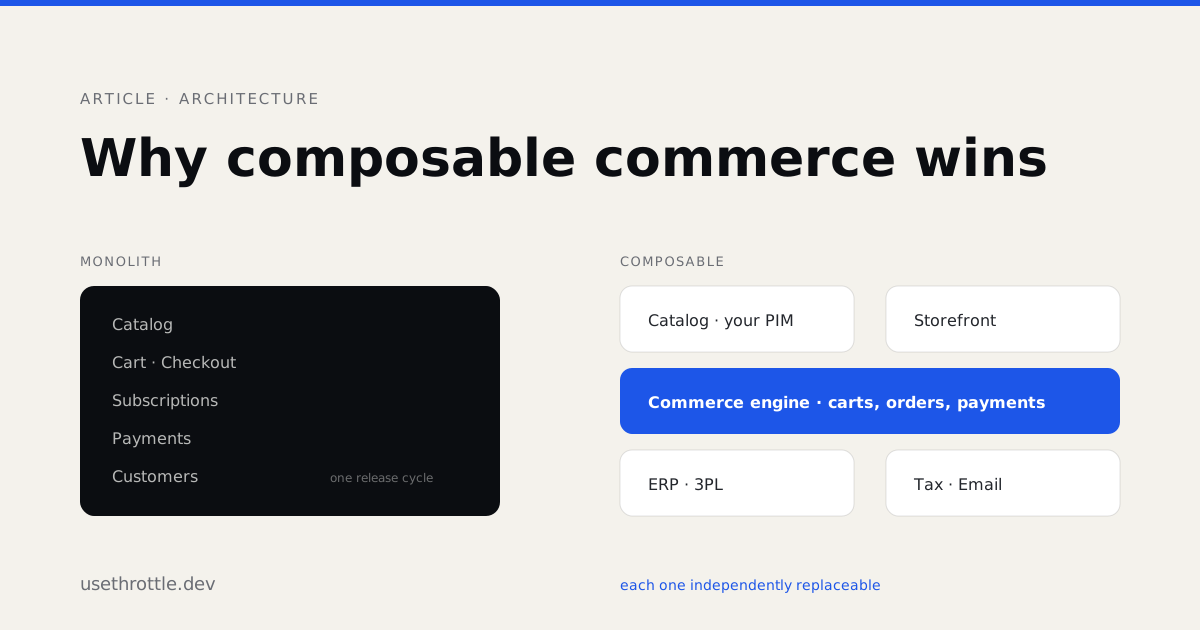
The real argument is narrower and harder to dismiss. In a monolith, every capability shares one release cycle and one data model. Your checkout, your subscriptions, your tax logic, and your catalog all move at the speed of a single vendor’s roadmap — and that roadmap is set by the needs of the median merchant on the platform, which is almost certainly not you.
Composable changes one thing: each capability becomes independently replaceable. That’s it. Everything else people claim for it follows from that property or doesn’t hold.
What the monolith actually costs
Not money. Optionality.
When your commerce platform owns the catalog, the cart, the checkout, the payment flow, the subscription logic, and the customer record, every one of those is a decision you’ve delegated permanently. Wanting to change one means changing all of them, because they’re the same system. That’s why replatforming is treated as a multi-quarter event rather than a normal engineering task — the unit of change is the entire platform.
The cost shows up as a series of small refusals. You can’t change the checkout step order. You can’t express that pricing rule. You can’t get that field into the order webhook. Individually each is minor and each has a workaround. Collectively they’re the reason your roadmap has a section called “things we’d do if the platform allowed it.”
A monolith is a bet that the vendor’s priorities will stay aligned with yours indefinitely. That bet is fine for a long time. It stops being fine at a specific and recognizable moment: when the workarounds start requiring their own maintenance.
What composable actually means
It does not mean using more tools. Using six vendors where you had one, wired together by brittle syncs, is worse than the monolith — you’ve kept the coupling and added network calls.
Composable means each capability is behind a contract you could swap the implementation behind. The test isn’t “how many vendors do I have,” it’s “what breaks if I replace this one.” If the answer is “everything, because four other systems read its database,” you have a distributed monolith.
Which is why the design decisions that matter are mostly about what a system refuses to own.
Throttle doesn’t store your products. There’s no catalog table, no PIM, no product import. Line items arrive from your storefront in the cart payload and are recorded on carts and orders with a reference back to whatever system owns the product. That’s a deliberate constraint, and it’s occasionally inconvenient — it means we can’t build catalog-aware features without you passing us the data.
The trade is that your catalog stays yours. Your PIM, your ERP, your CMS, your existing platform’s product data — none of it has to move, sync, or reconcile. The commerce engine has no opinion about where products live, so replacing the commerce engine doesn’t touch them. That’s what “independently replaceable” means when you take it seriously rather than as marketing.
The part nobody sells you
Composable is harder in specific ways, and pretending otherwise is how teams end up unhappy eighteen months in.
You own the seams. In a monolith, when the cart and the tax engine disagree, that’s the vendor’s bug. In a composable stack, it’s yours. The integration surface is real work, and it never fully goes away.
More vendors means more failure modes. Each one has its own uptime, its own rate limits, its own breaking changes. You need a strategy for that, not just a list of API keys.
It demands engineering judgment you may not have staffed. A monolith lets a small team run a large store because the platform makes the architectural decisions. Composable hands those decisions back. That’s the point, and it’s only an advantage if someone is prepared to make them.
The tooling is less mature. Admin UIs, reporting, and the long tail of operational surfaces are things monoliths have spent a decade polishing.
If you’re doing a few hundred orders a month on a standard catalog with standard fulfillment, a monolith is very likely the right answer, and anyone who tells you otherwise is selling something. The economics don’t favor composability until the workarounds cost more than the seams.
Where the line actually falls
Composable starts winning when one of these is true:
Your business logic doesn’t fit the platform’s model. Subscription rules, B2B terms, usage billing, complex fulfillment. If you’re maintaining code to work around the platform’s assumptions, you’re already paying for composability without getting it.
You have more than one storefront. Multiple brands, regions, or channels on one commerce backend is where the monolith’s single-tenant-per-store assumption gets expensive fast.
The commerce layer is a competitive surface. If how you sell is part of why customers choose you — the configurator, the pricing model, the checkout flow — you cannot afford it to be a vendor’s roadmap item.
Your integration count is growing. Every integration written against a monolith’s proprietary shape is a switching cost you’re volunteering for.
None of those is about scale. A $2M business with genuinely unusual mechanics needs composability more than a $50M business selling ordinary things in an ordinary way.
The honest framing
Composable isn’t inevitable and it isn’t universally correct. It’s a trade: you accept integration work and architectural responsibility, and in exchange no single vendor can cap what you build.
The question worth asking isn’t “is composable better.” It’s “how much does my next twelve months depend on a roadmap I don’t control.” If the answer is “not much,” stay where you are — genuinely. If you can name three things you’d ship this year if the platform allowed it, you already know the answer, and the only remaining question is whether you move deliberately or wait until something forces it.
If it’s the second one, the migration playbook covers what that actually involves — including the parts that are harder than the pitch.