An Agency's Guide to Recommending Throttle
The two ways agencies work with Throttle, what each one pays, and the client profile where recommending us is actually the right call.
Agencies get pitched partner programs constantly, and most of them are a referral link and a discount code. This is a description of ours, including the economics in enough detail that you can decide whether it’s worth your time before talking to anyone.
The short version: there are two programs, they pay very differently, and one of them requires us to approve you.
The two programs
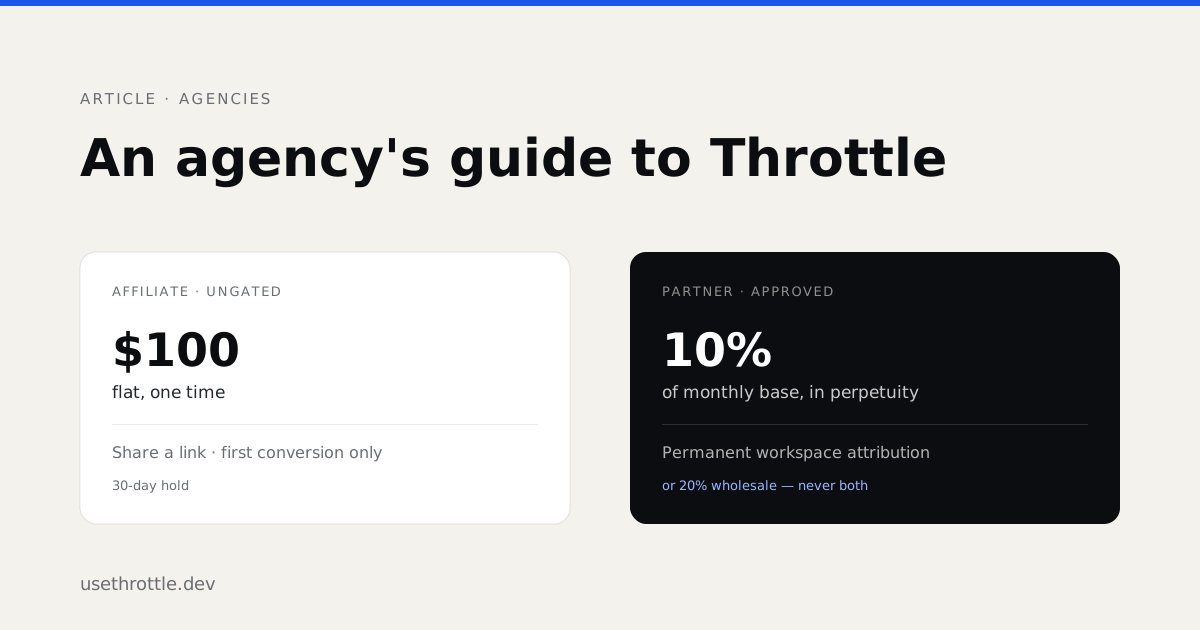
Affiliate is ungated. Anyone can join, you get a link with ?r=YOURCODE, and if someone signs up through it and converts, you’re paid a flat $100, once. Thirty-day holding period, voided if they refund or churn inside it. It doesn’t matter which plan they land on, and it doesn’t matter if they later add five more applications — the bounty is one hundred dollars, one time.
That’s deliberately not a residual. An ungated program that paid recurring commissions would be worth gaming, so it pays a bounty instead.
Partner requires manual approval and works differently in every respect. You create the client’s trial directly rather than sending them a link. Attribution is at the workspace level and permanent — every application that client runs, present and future, is attributed to you automatically. And it pays 10% of the monthly base fee, in perpetuity.
You can hold at most one referral per client workspace, so the two programs can’t both claim the same account.
What the 10% is actually calculated on
The monthly base fee only. Not the metered leg.
Plans are $100/mo (Starter), $300/mo (Growth), and $1,000/mo (Max), each plus $0.10 per transaction. Your commission is 10% of the base — so $10, $30, or $100 a month per application — and the per-transaction revenue is excluded.
Worked through: a client on Growth with $20 of transaction volume in a month bills $320. You earn $30, not $32.
That’s a smaller number than a percentage-of-everything program would advertise, and it’s stated this way on purpose. A commission on metered usage would make your income depend on your client’s transaction volume, which is not something either of us should want you optimizing for.
The compounding is in the permanence and the scope. A client with four applications on Growth is $120/month to you, indefinitely, and a fifth application joins automatically when it converts — no action from either side.
Or: you own the billing
If you’d rather hold the commercial relationship yourself, point the client’s billing at your workspace and you get a 20% wholesale discount on the base fee instead. You’re invoiced, you bill your client whatever you bill them, and the margin is yours.
You don’t get both. A workspace is either partner-paid at 20% off with no commission, or client-paid with your 10% commission. If you later hand the billing relationship over to the client, the discount stops and the 10% commission begins automatically.
One constraint worth knowing before you plan around it: billing ownership is set per workspace, while commission is calculated per application. So it’s all-or-nothing — every application in that workspace is discounted and none earn commission. You can’t mix the two arrangements inside one client.
Which is better depends on whether you want margin or income. The 20% discount is worth more per dollar at every tier, but it means you’re invoicing, collecting, and carrying the credit risk. The 10% is smaller and entirely passive.
The client profile this actually fits
Recommending the wrong platform costs you more than any commission is worth, so here is where we’re genuinely a good call — and where we aren’t.
Good fit:
- The client’s business logic doesn’t fit their current platform, and you’re maintaining workarounds that have become their own line item
- Subscriptions are core rather than incidental, especially with seat or usage components
- They need B2B terms — Net 30, quotes, approval flows — alongside consumer checkout
- Multiple storefronts, brands, or regions on one commerce backend
- They have, or you provide, engineers who can own a composable stack
Poor fit:
- A standard catalog with standard fulfillment doing modest volume. A monolith is cheaper and simpler, and we’ll tell them so.
- Nobody available to own integration work — ours or anyone’s
- They need a full admin and merchandising suite out of the box. We’re a commerce engine; the storefront and its tooling are yours to build.
- The pitch is purely cost. We’re not the cheapest option and we don’t try to be.
The second list matters more than the first. An agency that sends us three well-matched clients is worth considerably more to us than one that sends thirty and has half of them churn — and churn inside thirty days voids the referral anyway.
What we do on a migration
Migration support is included on every tier, which in practice means we’re in your planning calls rather than behind a ticket queue.
We handle the Throttle side: environment setup, connector configuration, reviewing your data mapping, running the parallel-run comparison, and coordinating with payment processors on vaulted card migration — that last one has a real lead time and is the item most likely to slip a launch date if it’s discovered late.
You own the storefront, the catalog, and the client relationship. We’re not going to show up and try to own the account; the whole model depends on that not happening.
For clients who want proof before committing, there’s a paid pilot: one product line or subscription stream migrated in parallel with their existing stack, at the Starter tier for the duration, then a decision.
Getting started
The affiliate program is self-serve — sign up and you have a link.
The partner program requires approval. You can apply from your workspace settings, and we look at the client work you’ve done and whether you have the engineering capacity to support a composable stack. It’s a real review, which is the reason the attribution is permanent and the commission never expires.
If you’re evaluating us for a specific client, skip both and just get in touch with their order shape and integration list. That conversation is more useful than any program page, and it’ll tell you faster than we can whether this is the right recommendation.